
Human-Valid Audience Impressions - A Proposal for Cross-Platform Viewability
We illustrate a technical proposal for cross-platform audience impressions and which is used as a basis for Quividi’s audience impression measurement.
This article explores what the factors are that can accelerate DOOH towards the “holy grail” of cross-platform media compatibility. In it, we will illustrate a technical proposal for cross-platform audience impressions and which is used as a basis for Quividi’s audience impression measurement. This article is also an excerpt from a larger work, Quividi's DOOH Audience Impressions White Paper which can be downloaded here.
What is Viewability in DOOH?
An ad is considered viewable in DOOH if it is qualified from two reciprocal perspectives: the audience’s, focused on their qualified presence in front of a screen, and the screen’s, which is focused on the qualified exposure of the advertisement in question. Both conditions at the same time for 1 second or more for a particular ad is qualified as an audience impression.
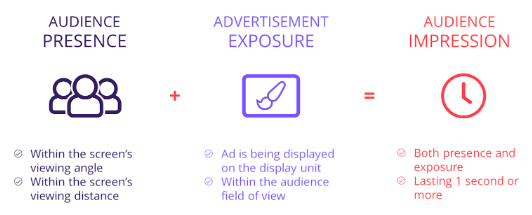 The definition of a DOOH audience impression in DOOH used in this document.
Qualified Ad Exposure
An ad exposure is qualified to be viewable if the ad is playing correctly as intended (no video aberrations or dropped frames) and, simultaneously, if the display is powered on and displaying the ad on its surface.
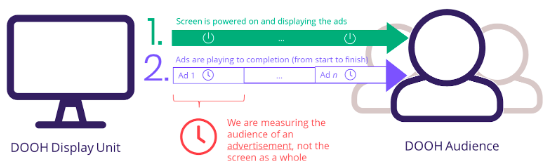
For an ad exposure to be Qualified, it needs to be playing the correct content and simultaneously the screen must be powered on and displaying that content.
If there is no audience presence, then the exposure is not qualified for audience impressions. This means advertisers only pay for human-valid impressions and do not pay for ad exposures when no one was there.
Audience Presence vs Notice
A long-standing debate between ad buyers and sellers is the definition of what is being bought and sold. Is it when the ad was noticed or when the ad was played in presence of individuals?
While the spirit of all advertising measurement standards is to arrive to as close as the count of individuals that saw a particular ad as possible, this can be biased to a degree by the quality of the ad creative content. This is why we distinguish between notice (aka attention) and qualified presence (aka an impression) which we define as the angle of head rotation (120⁰).
The standard today is to trade based on Audience Presence, but to qualify that presence to be as close to the actual audience as possible. Online advertising standards qualified that presence via the Viewability Condition; OOH via the Visibility Adjustment.
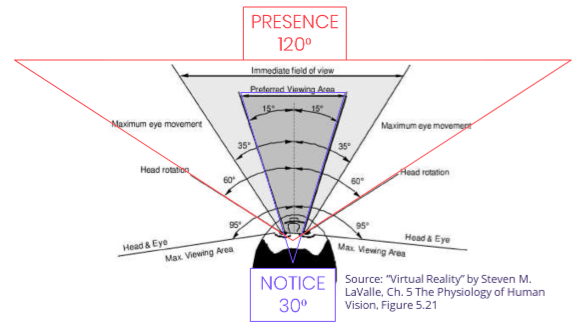
Two different ways of counting audience. Presence is based on the opportunity to see while Notice is based on the quality of the audience interaction.
Notice, being a function of the creative execution of the ad, is a separate domain of ad effectiveness measurement compared to the advertising transaction audience currency. For example, a campaign that uses a poor ad creative, that does a poor job at communicating should pay the same price for the media as someone that uses that media more effectively.
This isn’t to say that data about the quality of notice isn’t a key metric to help design better creative and get more value for the media investment. Quividi provides notice via its Attention metric. We are just saying that it is not the basis of the audience currencies nor online, nor out-of-home.
Field Of View And Viewing Angle
When the audience is said to be facing the screen, we say the screen is “In View”; otherwise, it is “Not In View”. A person’s facing direction is important because they cannot see an ad that is behind them. A person’s field of view is up to 120⁰ wide centered on their facing direction. Everything within the field of view is considered “In View”, else it is “Not In View”.
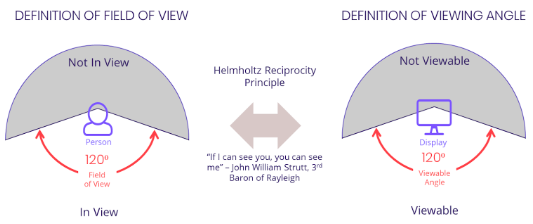 The angle of field of view of the audience corresponds to the viewing angle of the display.
A screen has a viewable angle which corresponds to the audience field of view due to Helmholtz reciprocity principle. Note, the viewable angle is the lesser of the two between 120 degrees and the display technology’s own viewing angle. Additionally, as explained later, occlusions in the field of view such as opaque walls, columns and even people will affect the viewable angle.
Audience Presence and The Screen’s Viewing Distance
A larger screen can be seen from further away than a smaller screen, which means a larger screen area has a larger viewing distance than a smaller screen. Since there are no public viewing distance standards in out-of-home, we have worked to determine a universal formula which may survive scrutiny across media (out-of-home and online).
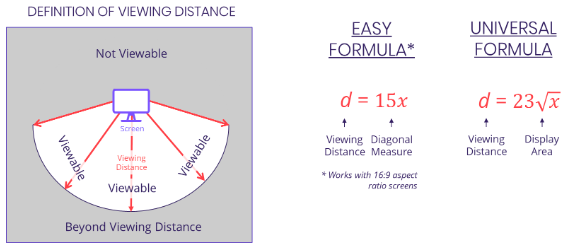 The radius formula is based on Federal Highway Administration (FHWA) standards and directives.
The formula to calculate the viewability distance for a screen is to multiply the square root of the display area by 23. A shorthand version for 16:9 aspect ratio screens is to multiply the diagonal measurement of the screen by 15. We based our formula on the Federal Highway Administration (FHWA) standards and directives for road traffic signage, which is used the world over.
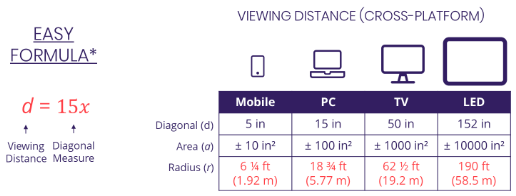 The formula scales well to other types of screens as well as demonstrated in this table.
DOOH AUDIENCE IMPRESSIONS ILLUSTRATED
Using the definition of an audience impression elucidated earlier in this document, we illustrate it using some basic scenarios.FACING DIRECTION: TOWARDS NOT AWAY
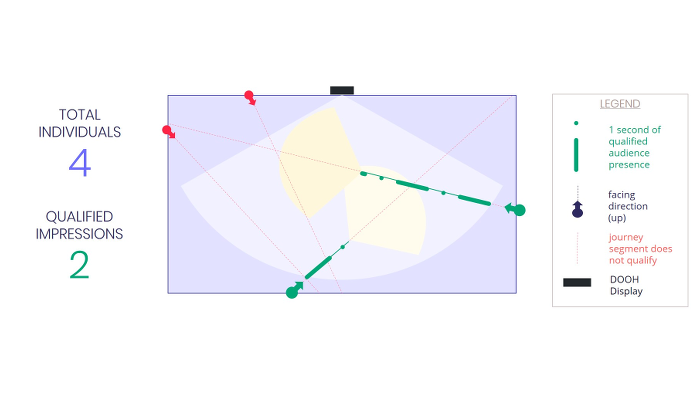
One of the fundamental questions regarding what constitutes an impression pertains to facing direction. We do not consider someone who is facing away from the screen a member of the audience.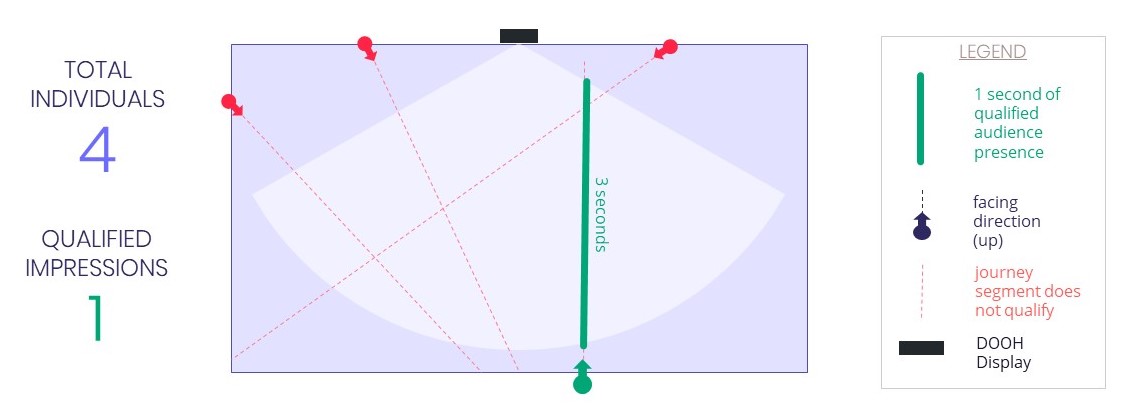 In this diagram only 1 out of 4 individuals that crossed into the viewability zone qualified as facing towards (in green).
PERPENDICULAR CROSS-TRAFFIC
Audience which is perpendicular to the screen is considered viewable if the screen is within view and not otherwise. This means that cross-traffic has qualified presence for only the part of the journey where the screen is in view.
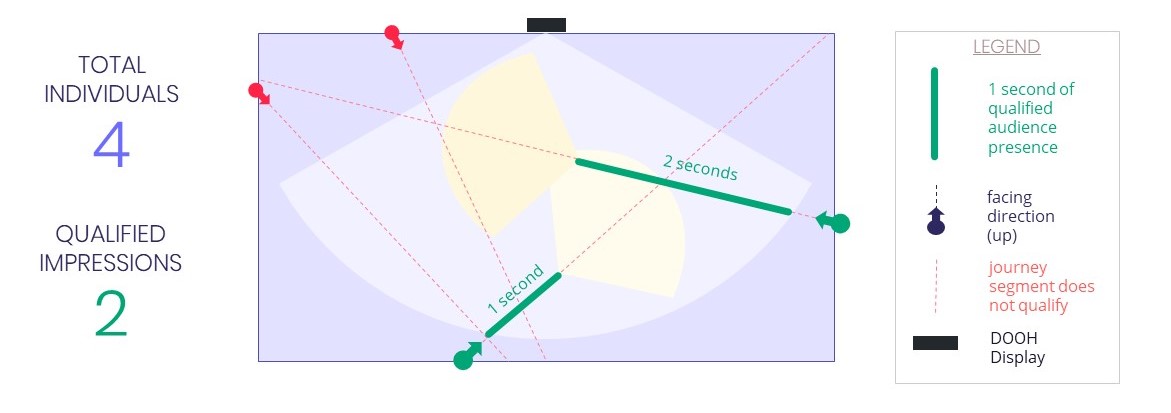 A person walking perpendicular to the screen, only has the screen in view for part of their journey. Once the screen is not in view, we cannot include them in audience presence.
Note, this does not consider the fact screens that are perpendicular to foot traffic also have higher rates of occlusion (humans temporarily occluding other humans). This is the next scenario.
CUMULATIVE UNOCCLUDED DURATION
For an ad to be considered viewable, the audience needs qualified presence and the ad needs to be exposed on the screen (both) without occlusions for a cumulative duration of at least 1 second. If there is something blocking the view of the screen, the ad is not considered viewable. A temporary interruption in viewability along an individual’s path for a small occlusion like a column does not disqualify an ad from being viewable in whole. It only interrupts the viewing duration which is evaluated cumulatively.
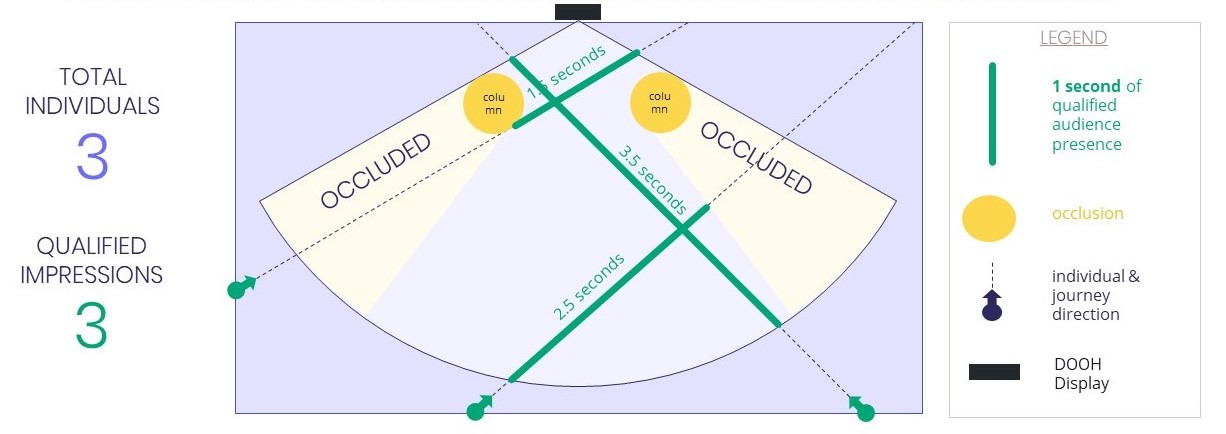 Here all 3 individuals qualify as impressions since they are all unoccluded for at least 1 second.
In a cross-traffic scenario, individuals would have their view of the screen occluded temporarily, and if it was particularly busy some might never have a clear view of the screen.
Conclusion
In conclusion, in this article we illustrate a technical standard for audience impressions which is compatible in principle with OOH standards and those online, and which is based on human-validity. This is the standard on which Quividi measures audience impressions.
Bring us your network. We’ll show you the data.
Thirty minutes with a Quividi solutions architect, your fleet topology, a sandbox you can poke at.