
Verified attention for mobile DOOH, in a World Cup crowd.
Context
Mobile DOOH has never struggled to move media through a crowd. What it has struggled to prove is that anyone looked. Human-carried screens are counted in routes walked and hours covered, which tells an advertiser almost nothing about attention.
The Backpackster set out to close that gap in the least forgiving conditions available: the pedestrian entrances and exits around SoFi Stadium during a World Cup activation, where the crowd is dense, fast-moving and distracted by the event itself.
Deployment
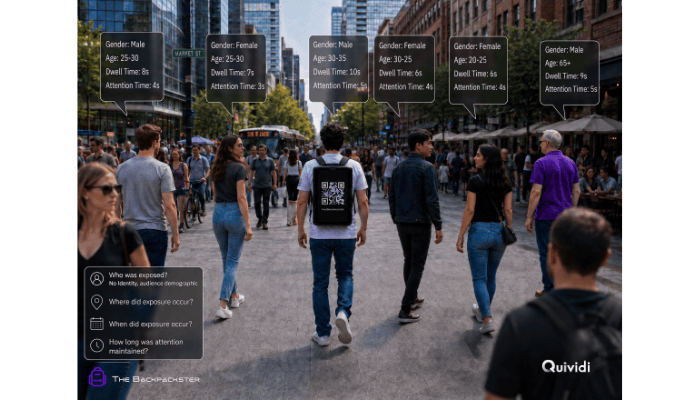
Backpackster units carrying several brands' campaigns were deployed at primary entry and exit points around the stadium. Quividi measured the audience at each unit in real time, processing camera data on the device to produce anonymous, aggregate audience statistics, with no images retained and nothing personally identifiable stored.
What changed
The activation delivered 17,111 advertising impressions, of which 2,540 were verified viewers and 1,148 engaged with the content for more than two seconds. Average attention time was 2.95 seconds against 7.5 seconds of dwell, broken down by creative so the brands could see which executions held people longest.
Beyond the numbers, fans stopped, pointed the units out to friends and photographed them on the way to the matches. Both companies plan to extend the work into new markets, connecting verified attention to attribution and business outcomes.
A moving screen becomes accountable media the moment every impression can be qualified.
Three stories that share DNA.
Bring us your network. We’ll show you the data.
Thirty minutes with a Quividi solutions architect, your fleet topology, a sandbox you can poke at.